Powered By Blogger

Touristic Sites In Jordan

Amman is the capital of the Hashemite Kingdom Of Jordan Near Amman (AlSalt,Wadi Seer) 1-- North and West of Amman(Jerash,‘Ajloun,Irbid,Umm Qais,Hemma,Umm al-Jimal) The Jordan Valley(The River Jordan,The Dead Sea,Deir Ain Abata Deir ‘Alla,Tabaqat Fahl) 2-- East of Amman: The Desert Castle Loop(Qasr al-Hallabat,Azraq Oasis,Qasr al-Azraq,Shomari Wildlife Reserve ,Qusayr ‘Amra,Qasr al-Harraneh,Qasr al-Mushatta Qastal) 3-- South of Amman(The King’sHighway,Madaba,MountNebo, Mkawer,Hammamat Ma’een,Karak,Khirbet al-Tannur,Tafileh ,Shobak,Dana Nature Reserve Wadi Rum) 4-- Petra 5-- Aqaba 6-- The Ancient Holy Land 7-- Islamic Holy Sites in Jordan
Showing posts with label Aqaba. Show all posts

Saturday, March 31, 2012

Abbasid Mosque


Abbasid Mosque


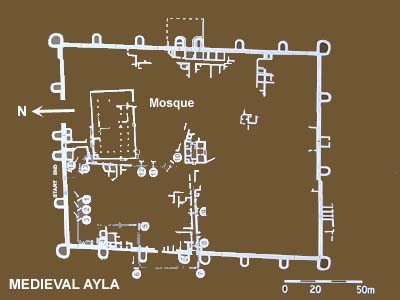
Medieval Ayla 
Aqaba, Jordan
The Blue Guide dates this mosque, at least in its present form, between the mid-8th century and mid-9th century AD. It is a mosque for congregational worship, with a peristyle courtyard. Read this photo from left (north), to right (south). The mosque is seen here from the west side; the front, and longer (sic), side of the building is north .
From the columned entrance (1), worshipers passed into a large rectangular courtyard (2), and continued through another row of columns and into the first prayer hall (3). Past yet another row of columns is the inner prayer hall, with a mihrab (A niche in the wall of a mosque that is oriented towards Mecca, the direction of prayer (qibla); for example, towards the west, when one is in India) on the south wall (4). The dimensions of the mosque are approximately 30m (N-S) by 50m (E-W).
Medieval Ayla is located on the beach of modern Aqaba, Jordan's port on the Red Sea.

Tuesday, March 20, 2012

Allat Temple

Allat Temple

Wadi Rum, Jordan


Located an hour's drive east of Aqaba in Southern Jordan, Wadi Rum was the spectacular setting for Nabataean temples, villas, and baths, as well as for the movie Lawrence of Arabia (later pages). Seen here is a temple to Allat, the Arabian goddess who was a consort of Dushara and who was identified with Athena. The temple is dated to the early first century AD, reign of Aretas IV.
 
 Its plan is similar to other Nabataean temples, like the Winged Lions temple at Petra, or the temple at Khirbet Tannur.


The photo looks west, towards the shrine. Engaged columns surround the cella. They were originally painted in red, blue, and yellow.

Sunday, March 4, 2012

Geography, Birdlife & Marine Life


 Birdlife
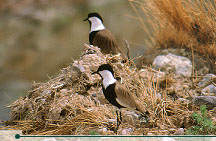
Spur-winged Plovers in Safi. © Jad Al Younis, Discovery Eco-Tourism
Jordan also possesses a large and varied assortment of birdlife. This can be traced, once again, to the variety of habitats found within the country–from mountains forests to desert oases, from high cliffs to sweeping deserts, and from deep gorges to broadwadis. Two distinct types of avifauna can be found in Jordan: those species which stay year-round, and migratory visitors.

At the junction of the Mediterranean and Arabian faunal regions, Jordan lies on one of the world’s major bird migration routes, between Africa and Eurasia. Before the water levels of the Azraq Reserve were depleted over the past ten years, up to 200,000 birds–including spoonbills, white pelicans, egrets, terns and gulls, to name a few–would congregate there at one time during the migratory season. The numbers of migrants have decreased as Azraq has grown drier, yet even today up to 220 migratory species continue to transit through Jordan on their journey north or south. The approximately 150 species which are indigenous to Jordan seem not to have been affected greatly by the great drought of the 1980s.


 Marine Life
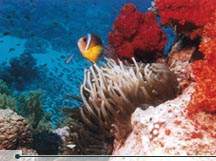
The Gulf of Aqaba is home to some of the finest marine life in the Middle East, while its coral reefs are unmatched in the world. The gulf is very narrow–at its northern end it is only five kilometers wide–and quite deep, ranging in depth from between 1000 to 1800 meters. The depth of the gulf, combined with its isolation from sea currents, minimize turbulence and improve visibility. On the sandy shores, one can find creatures such as the ghost crab, sandhoppers and the mole crab.
Gulf of Aqaba

The sea waters, meanwhile, host a plethora of marine life including starfish, sea cucumbers, crabs, shrimps, sea urchins, many species of fish and several worms which burrow into the sandy sea bottom. A variety of sea grasses can be found in the shallow waters, providing both food and shelter to the fishes which inhabit the area. Several species of eel make their home in the gulf’s grass beds, where one can also find sea horses and pipe fishes.
Marine meadow beneath the surface of the Gulf of Aqaba. © Camerapix 1994
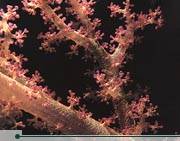
Perhaps the greatest attraction for divers in the Gulf of Aqaba is the colorful coral reefs, found especially near the southern part of Jordan’s coastline. There are around 100 varieties of stony coral, and they are found mainly in shallow waters, as the algae that live within them require light for photosynthesis. Many hundreds of fish species make their homes among the reefs, and some live by eating the algae that grows on the coral.


Thursday, March 1, 2012

Geography


 The Jordan Valley
The Jordan Valley, which extends down the entire western flank of Jordan, is the country’s most distinctive natural feature. The Jordan Valley forms part of the Great Rift Valley of Africa, which extends down from southern Turkey through Lebanon and Syria to the salty depression of the Dead Sea, where it continues south through Aqaba and the Red Sea to eastern Africa. This fissure was created 20 million years ago by shifting tectonic plates.


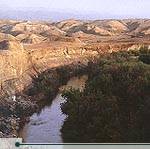
The northern segment of the Jordan Valley, known in Arabic as theGhor, is the nation’s most fertile region. It contains the Jordan River and extends from the northern border down to the Dead Sea. TheJordan River rises from several sources, mainly the Anti-Lebanon Mountains in Syria, and flows down into Lake Tiberias (the Sea of Galilee), 212 meters below sea level. It then drains into the Dead Sea which, at 407 meters below sea level, is the lowest point on earth. The river is between 20 and 30 meters wide near its endpoint. Its flow has been much reduced and its salinity increased because significant amounts have been diverted for irrigational uses. Several degrees warmer than the rest of the country, its year-round agricultural climate, fertile soils, higher winter rainfall and extensive summer irrigation have made the Ghor the food bowl of Jordan.

The Jordan River ends at the Dead Sea, which, at a level of over 407 meters below sea level, is the lowest place on the earth’s surface. It is landlocked and fed by the Jordan River and run-off from side wadis. With no outlet to the sea, intense evaporation concentrates its mineral salts and produces a hypersaline solution. The sea is saturated with salt and minerals–its salt content is about eight times higher than that of the world’s ocean–and earns its name by virtue of the fact that it supports no indigenous plant or animal life. The Dead Sea and the neighboring Zarqa Ma’een hot springs are famous for their therapeutic mineral waters, drawing visitors from all over the world.
 
Wadi Araba. © Zohrab
South of the Dead Sea, the Jordan Valley runs on through hot, dry Wadi ‘Araba. This spectacular valley is 155 kilometers long and is known for the sheer, barren sides of its mountains. Its primary economic contribution is through potash mining. Wadi ‘Araba rises from 300 meters below sea level at its northern end to 355 meters above sea level at Jabal Risha, and then drops down again to sea level at Aqaba.

The seaside city of Aqaba is Jordan’s only outlet to the sea. Its 40 kilometer-long coastline houses not only a tourist resort and Jordan’s only port, but also some of the finest coral reefs in the world. The rich marine life of these reefs provides excellent opportunities for snorkeling and diving.


Monday, February 27, 2012

Aqaba

South of Amman

 Aqaba

With its balmy winter climate and idyllic setting, Aqaba is Jordan’s year-round aquatic playground. In winter, while Amman shivers around 5ºC (41ºF), the temperature hovers steadily at about 25ºC (77ºF) in Aqaba. The thriving underwater marine life and the crystal clear waters of the Gulf of Aqaba make diving conditions there among the acknowledged best in the world. Snorkeling, water skiing, windsurfing, fishing and other water sports are also popular.
The port city of Aqaba. © Michelle Woodward
For the history enthusiast, Aqaba contains sites reflecting human habitation back to 4000 BCE, resulting from the city’s strategic location at the junction of trading routes between Asia, Africa and Europe. According to the Bible, "King Solomon also built ships in Ezion-Geber, which is near Elath in Edom, on the shores of the Red Sea." This verse from the Old Testament (1 Kings 9: 26) probably refers to an Iron Age port city on the same ground as modern Aqaba. The name Elath refers to the Israeli town of Eilat. The Queen of Sheba (ancient Yemen) traveled from Jerusalem to the port city of Ezion Geber to visit the splendorous court of King Solomon in the tenth century BCE (1 Kings 10: 1-13).
The remains of what is believed to be the oldest church in the world, Aqaba. © Michelle Woodward

In one of the most exciting discoveries in recent times, archeologists working in Aqaba have unearthed what they believe to be the world’s oldest church. Dating from the late third century CE, the 26 x 16 meters structure is thought to be the oldest building built specifically as a church. It is slightly older than the Church of the Holy Sepulchre in Jerusalem, and the Church of the Nativity in Bethlehem, both of which date from the fourth century. The church is found on a plot of land east of Istiqlal Street, near the parking lot of the JETT bus station

Trading routes developed connecting Aqaba with southern Arabia and Yemen, and the town grew into a thriving city. The Nabateans populated the region extensively, drawn by the strategic trading location of Aqaba. In Roman times, the great Via Nova Triana came down from Damascus through Amman to Aqaba, where it connected with a west road leading to Palestine and Egypt.

The early days of the Islamic era saw the construction of the city of Ayla, which was described by the geographer Shams Eddin Muqaddasi as situated next to the true settlement, which was lying in ruins closeby. The ruins of Ayla, unearthed in the mid-1980s by a American-Jordanian archeological team, are a few minutes walk north along the main waterfront road.

The Crusaders occupied the area in the 12th century and built their fortress of Helim, which remains relatively well-preserved today. The Aqaba fort was rebuilt in the 14th century under one of the last Mamluk sultans, Qansah al-Ghouri, and has been substantially altered several times since then. The Hashemite Coat of Arms was placed above the main doorway during the Great Arab Revolt of World War I, after the Turks were driven out of the city. The fort is open daily and entrance is free.

In addition to building a stronghold within Aqaba, the Crusaders fortified the small island of Ile de Graye, now known as Pharoah’s Island, about seven kilometers offshore. The island, which is now in Egyptian territorial waters, can be reached via tour excursions which leave from the Aquamarina Hotel.

By 1170, both Aqaba and the island had been conquered by Salah Eddin. The Mamluks took over in 1250, but by the beginning of the sixth century they had been overtaken by the Ottoman Empire. The city then declined in status, and for 400 years or so it remained a simple fishing village of little significance. During World War I, however, Ottoman forces were forced to withdraw from the town after a raid by Lawrence of Arabia and the Arab forces of Sharif Hussein. The capture of Aqaba helped open supply lines from Egypt up to Arab and British forces afield further north in Transjordan and Palestine.

In 1965, King Hussein traded 6000 square kilometers of Jordanian desert to Saudi Arabia for another 12 kilometers of prime coastline to the south of Aqaba. This gave Jordan’s only port room to expand and added the magnificent Yamanieh coral reef to the Kingdom’s list of treasures.

With its tranquil, clear waters and thriving marine populations, Aqaba is ideal for divers as well as casual water sports enthusiasts. As the Gulf of Aqaba is an inland sea with few strong currents, its waters remain warm and clear throughout most of the year. Conditions are ideal for underwater photography, and a lavish array of exotic fish and plant life makes for excellent snorkeling and diving. Over 140 species of coral have been identified in Aqaba’s waters.

There are several diving centers in Aqaba, the most prominent of which are the Aquamarina I Hotel (tel. 03-201-6275), the government-run Royal Diving Center (tel. 03-201-7035), and the Seastar Watersports Center in the Al-Cazar Hotel (tel. 03-201-4131). The Aquamarina I also offers a number of other aquatic activities, including windsurfing, waterskiing, and, for the less adventurous, paddle-boats. A new diving area is being developed near the Saudi border near the world-famous Yamanieh coral reef. This complex, known as the South Coast, will have an assortment of hotels, parks, restaurants and watersport facilities.

For up-to-date information on where to go to enjoy your favorite aquatic activities in Aqaba, theAqaba Visitors Center (tel. 03-201-3731) is located behind the Aqaba fort by the waterfront. The office is open daily from 08:00 to 16:00, and closed on Tuesday. Located in back of the Visitors Center, the Aqaba Museum displays a number of exhibits and plenty of information on the old city. The museum was once home to Sharif Hussein bin Ali, great-grandfather of King Hussein.